

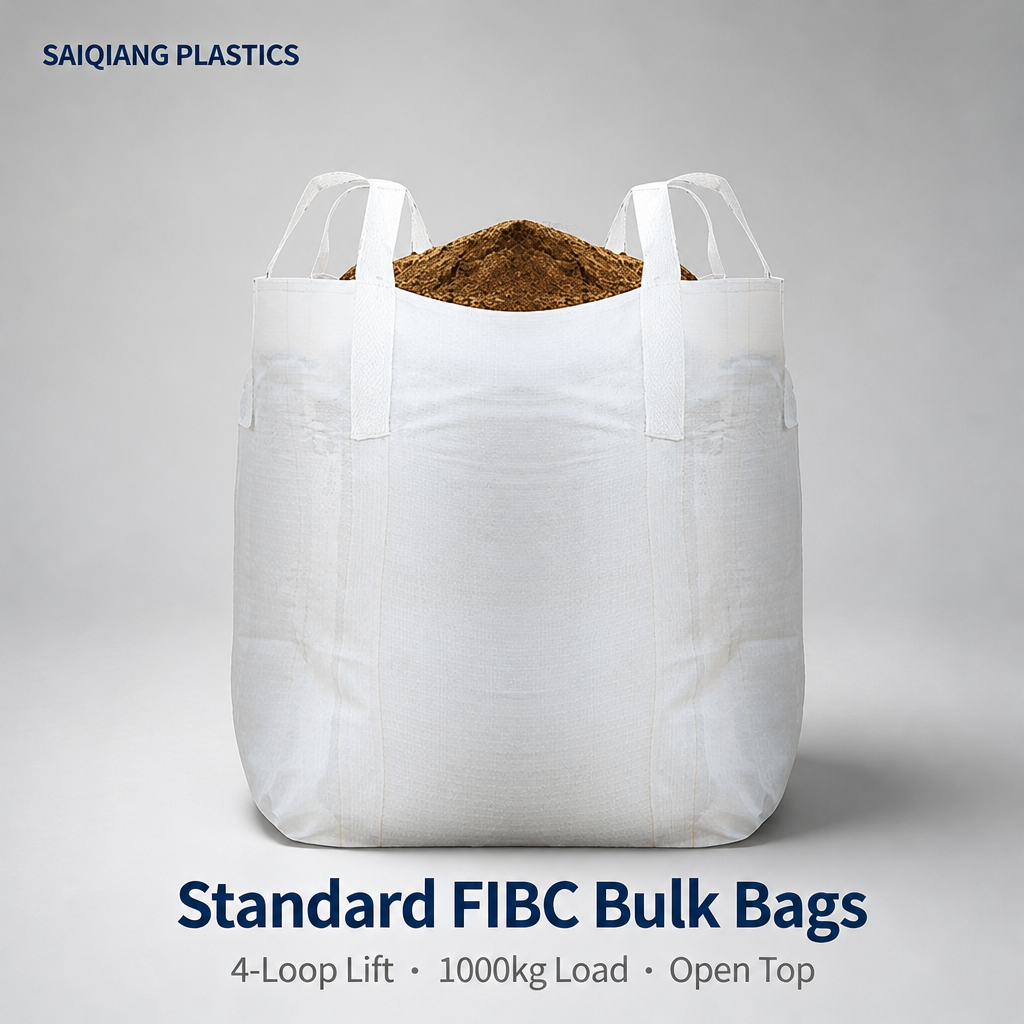
Not every bulk shipment needs a reusable bag, and paying for one wastes money. A one-way FIBC is built for a single safe journey: fabric, loops and seams are sized to the load and the route, and the bag is retired when the load arrives. For minerals, aggregates, ores and construction waste that move once and reach the end user directly, that is the cheapest way to ship a tonne. Bulk bag cost on this basis is decided by fabric weight and rated load, not by a reuse cycle the bag will never see.
Our one way FIBC bags are designed around the fabric weight and safety factor your product and route actually need. The standard range runs from 160 to 220 gsm UV stabilised PP woven fabric, rated 500, 1000, 1500 or 2000 kg, with a 5:1 safety factor as standard and 6:1 on request. Nothing is over-engineered and nothing is quietly under-specified, which is where most Packaging cost reduction comes from: a bag that lifts the load once, without a reuse margin priced into every piece.
They suit aggregates, minerals, ores, construction waste and other materials that move once and arrive at the end user.
| Rated load | 500 / 1000 / 1500 / 2000 kg |
| Fabric | PP woven, 160-220 gsm, UV stabilised |
| Safety factor | 5:1 standard, 6:1 on request |
| Lifting | 4 corner loops, 70 mm webbing, double-stitched |
| Top and bottom | Open top, flat bottom; filling spout, duffle, discharge spout or iris optional |
| Printing and MOQ | Flexographic, up to 4 colours; from 500 pieces |
A 5:1 safety factor describes one journey, not a service life. The rating means the bag is tested to five times its working load before the first lift, so a 1000 kg bag has been proven at 5000 kg once. Repeating that journey is a different question: UV stabiliser is added for weeks outdoors rather than seasons, and a single trip bag left in the yard through a summer loses fabric strength long before it loses its shape.
Reuse also wears the mechanical parts first. The 70 mm webbing loops are folded into the body seam and bar-tacked where the load pulls hardest, and every lift works those roots. Second-hand bags carry the previous product's residue as well, which matters as soon as the next load is a feed or fertiliser blend. For goods that only need to move once, spending the difference on a heavier fabric for that single journey is the better trade than buying a bag rated for trips it will not make.
Two bags can carry the same 1000 kg and behave quite differently on site. The body is woven into either a U-panel or a four-panel construction: the U-panel runs one continuous sheet around three sides with a single seam at the back, while the four-panel version closes a seam at each corner and holds a squarer footprint when filled. A bag that has to sit square on a pallet or in a container row is easier to plan with the four-panel body; a bag that is filled and lifted straight onto a truck rarely needs the extra seaming.
The top and bottom decide how the bag meets your line. An open top takes a chute, auger or conveyor without a filling spout to line up, which is why it stays the default on a one way jumbo bag. A discharge spout or an iris at the bottom lets the receiving plant empty into a hopper instead of tipping the bag, so it is worth asking whether the destination has the equipment before the bag is made.
Even as single trip FIBC bags, our products are manufactured under strict quality control with tested lifting loops and secure seams. Fabric weight, seam strength, loop pull strength, UV treatment and bag dimensions are checked per batch, and filled bags are drop tested and lift tested at the rated load before shipment. Options include cross-corner loops, filling spouts and discharge spouts to suit your handling equipment, plus custom printing for clear identification.
As a one-way jumbo bag manufacturer, we customize capacity, fabric type, loop configuration and printing to your exact specification, and a loose or sewn-in PE liner can be added where the load needs a moisture barrier. Flexographic printing carries up to four colours, enough for a logo, product name and batch field. Our economical bulk bags deliver the performance you need without paying for features you do not.
With years of export experience, we supply disposable jumbo bags and one way FIBC products to buyers worldwide with professional documentation and on-time delivery. Ordering starts at 500 pieces per size and design, and a Packaging bag price per piece depends on fabric weight, load rating, closures, liner and colours, so a woven bag quotation is built from your own dimensions rather than a list price.
Buyers who want to compare construction before deciding can review the four-loop body rated 500 to 2000 kg, then send your fill weight, route and quantity for a bag supplier quotation with the artwork included.
Price depends on the rated load, fabric weight, top and bottom configuration, whether a liner is fitted and how many colours are printed. Two bags of the same 90 x 90 x 110 cm size can differ substantially once those are specified, so quotations are built from your dimensions and quantity rather than a public list price. Minimum order quantity is 500 pieces per size and design.
It is not recommended. The 5:1 safety factor covers one journey and one test before the first lift, not a service life. UV stabiliser is added for weeks outdoors rather than seasons, the loop roots take the full load on every lift, and residue from the previous product stays in the weave. If the load has to move more than once, specify a bag built for reuse from the start.
5:1 is the standard for single-trip industrial use and covers most mineral, aggregate and construction loads. 6:1 is available on request where your own standard or your customer's specification requires it. The higher factor is not a licence to overload: the rated load on the bag is still the maximum fill weight, and the safety factor only describes the test margin above it.
Orders start at 500 pieces per size and design, which is also the point where custom flexographic printing becomes practical. Below that, the set-up for weaving, cutting and printing is spread over too few bags to be economical. Mixed sizes and designs can be discussed against a single order where the quantities per reference stay workable.

This website uses cookies to ensure you get the best experience on our website.


 Español
 Portugues
 Pусский
 Français
 العربية


 WhatsApp
 Phone
 E-mail
 Message
Comment
(0)